


In this guide, I have listed the top AI voice agent platforms that sound natural and offer a personalized customer experience. These platforms resolved customer queries instantly with context and intent.
10 Best AI voice agent platforms in 2026: At a glance
I personally tested and reviewed the best AI voice agents that automate inbound and outbound calls and schedule appointments 24/7, 365 days a year.
| AI Voice Platforms | Best For |
|---|---|
| 1. MirrorFly | The #1 White-label AI Voice Agent Solution |
| 2. Apphitect | Best for Customizeable AI voice agent development |
| 3. Telnyx | Best AI employee with voice assistance |
| 4. Lindy AI | The User-friendly AI Agent Provider |
| 5. Vapi AI | Best conversational AI platform |
| 6. ElevenLabs | Best free voice generator platform |
| 7. CallHippo | AI-Powered Voice Agent for Enhanced Customer Interactions |
| 8. Deepgram | Best speech-to-text voice agent API |
| 9. SynthFlow | Best AI voice agent engine |
| 10. Bland AI | Best AI phone call agent platform |
Let’s start with a detailed AI Voice Agent
1. MirrorFly AI: The #1 White-label AI Voice Agent Solution
After 3 projects with MirrorFly, I feel MirrorFly is the most customizable solution to build AI voice agent platforms. I had an app already and just added MirrorFly’s pre-built widget to get my agent up and running.
In another project, I combined MirrorFly’s voice call API + AI voice agent solution to develop a whole new app from scratch within 24 hrs. This is a go-to option if you are looking for a quick solution to build AI-powered bots and assistants for your business.
MirrorFly’s AI voice agent solution comes with over 500+ AI-powered features – all of them customizable. You can train the agents with your own organizational data and use custom guardrails to set boundaries to the agents. The ownership of very data across the agent stays with the business owners, which is a great relief for independent entrepreneurs like me.
Once the integration is complete, you can run the agent on your own server. This is particularly suitable for large scale businesses that have their own on-premise server.
Key Features Of MirrorFly AI Voice Agent:
- Agentic AI
- AI chatbots
- AI customer service agents
- AI on-demand agents
- AI Video KYC
- IVR agents
- Natural Language Processing (NLP)
- Multi-language & accent support
- Real-time speech recognition
- Text-to-Speech (TTS)
- Call routing & IVR automation
- Sentiment analysis & emotion detection
- Conversation handling
- Context retention
- CRM & ticketing integration
- Call summarization & transcription
What is the cost of MirrorFly AI Voice Agent?
- Custom Pricing Model:
MirrorFly is a solution that’s carefully built for Developers, considering the balance of both features and budget. It is available for a one-time license cost and the pricing depends on your usage volume, features you need, and size of business.
But, if you’d like to go with a monthly subscription, that’s available as well. The pricing starts from $0.002 (0.2 cents) per user per day.
Reasons to Choose MirrorFly:
- 100% customisation: Everything from features to workflow is customizable with MirrorFly. You can train your voice agent with AI capabilities just the way you want according to your business needs.
- Data ownership: Only you’ll have all the access to your data. Not even MirrorFly AI Voice agent platform will be able to read the conversations or peek into your user information, although you build with it.
- Custom security: MirrorFly is closely the only provider that can customize the security encryptions and privacy layers.
2. Apphitect: The 100% Customizable AI Voice Agent Solution
Apphitect AI voice agent solution is a plug-and-play widget that you can add to your source code, train it to understand what app users might ask and generate responses accordingly.
I tested it for appointment booking and connected with Hubspot to see if the tickets were retrieved as expected – It did. I had the list of tickets in the agent dashboard and also options to customize the agent workflow with a built-in builder. The client requirement strictly leaned towards branding elements, and Apphitect allowed me to add the exact colors, logo and tone to the agent.
So far, I’ve built agents that work across sales teams, doctor appointment booking, consultation apps, and ecommerce support with Apphitect’s AI agents. I had a creative block while setting up the workflow, and the team kindly offered the help I needed to get things done the right way.
Key Features Of Apphitect AI Voice Agent:
- Autonomous task execution
- Multi-step decision-making
- Dynamic reasoning & planning
- Goal-based automation
- Self-learning with feedback
- API data fetching
- Real-time context awareness
- Memory & state retention
- Error detection & recovery
- Adaptive prompts
- Multi-agent collaboration
- Task prioritization
- Human-in-the-loop overrides
- Proactive action-taking
What is the cost of Apphitect AI Voice Agent?
Custom Pricing:
Apphitect’s AI voice agent is a custom solution. The team delivers the solution curated for business-specific operations and the pricing solely depends on this criteria. You can directly connect with their experts, discuss your requirements and get your free quote.
Reasons to Choose Apphitect:
- Plug-and-play widget: Apphitect does not require you to write codes. The entire agent set up is easy with a pre-build widget that you can simply add to your app. Other way around, you can use their CPaaS solution and conversational AI solution together to build custom AI voice agent platforms.
- White-labeling: You choose how your AI voice agents work, talk and look. The entire agent can be personalized with your own logo, colors and brand elements.
- Guardrails and AI moderation: You set the boundaries for the agent – what to answer, and what not to. This gives total control of how your agent responds. Along with this, you can set AI moderation to ensure the integrity across agent-customer interactions is maintained.
3. Telnyx: Low Latency AI Voice Agent
Telnyx helps you build production-ready AI voice agents for businesses of any size with its voice API. It provides direct-to-carrier connectivity and full-stack control, which delivers lower latency, higher reliability & better call quality. Telnyx Voice AI Agents allow you to stream calls directly to your own or third-party AI engines, thus enabling adaptive, human-like conversations. No patchwork integrations. You can buy numbers for your voice AI agent through dedicated platforms like Telynx.
Moreover, Telnyx offers a global private network where voice call congestion, packet loss, and variable routing are prevented.
Key Features of Telnyx Voice AI Agent:
- AI Voice Agents & Programmable Voice API
- Intelligent Call Routing and Control
- Global Number Provisioning
- AI Speech Model Integration (first- or third-party engines)
- IVR Automation and Outbound Engagement
- Secure, Private Network Backbone
- Scalable Infrastructure for Enterprise Use Cases
Pricing:
Flexible pay-as-you-go pricing (here, rates are based on usage volume, call destinations & features)
Reasons to Choose Telnyx:
- Low Latency & Highly Reliable: Direct-to-carrier connectivity make sure real-time responsiveness for AI voice interactions.
- Full Stack Control: Manage SIP, WebRTC, call flows, and media streaming in one platform. No third party involved.
- Global Reach: Provision numbers and route calls across 140+ countries.
- Enterprise-Grade Security: Encrypted voice streams, private backbone, and compliance-ready architecture for regulated industries.
4. Lindy AI: The Autonomous AI Agent Builder
I used Lindy AI to build an autonomous AI sales agent. The agent had to do repetitive tasks like scheduling client meetings, researching on the client requirements, perform outreach activities and execute in-house workflows.
After all this, the agent had to integrate with Zoho CRM to connect the conversational data to their team’s central database. Lindy was super-helpful and the agent was a success for the project.
Key Features of Lindy AI Voice Agent
- Autonomous Task Execution
- Workflow Builder
- Multi-tool Integrations
- Team Collaboration Features
What is the cost of Lindy AI Voice Agent?
Starts with a free plan suitable for trying out basic agents.
Reasons to Choose Lindy AI Voice Agent
- Automation Focus: If your business wants AI agents that actually complete tasks instead of just responding, go for Lindy.
- Collaboration Ready: Works specifically well with teams that need agents that work across multiple departments.
5. Vapi AI: The Developer-first Voice AI Infrastructure
I’d recommend Vapi if you are planning to create advanced AI meeting agents. It is great for creating custom flows and integrates easily with all of your databases, CRMs, and knowledge bases.
Key Features:
- Real-time Voice Agent APIs
- High-quality Speech Recognition
- Customizable Call Flows
- CRM and Database Integrations
What is the cost of Vapi AI Voice Agent?
Usage-based pricing with a generous free tier for testing.
Reasons to Choose Vapi AI Voice Agent
- Technical Flexibility: Great for tech teams who want to deeply customize behavior.
- Scalable Infrastructure: Built for businesses that expect high call volumes.
6. Eleven Labs: The Industry-leading Voice Synthesis Platform
Eleven Labs is one of the best AI voice agent development companies in the market. It is an unmatched option for naturalness and clarity. You can create AI voice agents that sound both realistic and emotionally expressive.
Key Features :
- Ultra-realistic Text to Speech
- Voice Cloning
- Multilingual Voices
- Emotional Tone Controls
What is the cost of Eleven Labs AI Voice Agent?
Flexible subscription plans with a free tier.
Reasons to Choose Eleven Labs AI Voice Agent
- Best-in-class Quality: Perfect if you want an AI voice agent that sounds as close to human as possible.
- Brand-driven Experience: Great for businesses that want unique brand voices and memorable interactions.
7. Deepgram: The High-accuracy Speech Recognition Engine
If your voice agent relies on precise understanding of customer speech, go for Deepgram. It is a highly reliable option if you are looking for a ready-made customer service agent.
Key Features :
- High-accuracy Speech Recognition
- Real-time and Batch Transcription
- Multilingual Models
- Custom Acoustic Models
What is the cost of Deepgram AI Voice Agent?
Pay as you go pricing with a free tier for initial testing.
Reasons to Choose Deepgram AI Voice Agent
- Superior Accuracy: Useful for businesses that handle complex, noisy, or technical conversations.
- Developer Friendly: Easy API integration for building scalable voice applications.
8. CallHippo: AI-Powered Voice Agent for Enhanced Customer Interactions
CallHippo offers a robust AI Voice Agent designed to streamline customer service operations by automating call handling and providing 24/7 support. Leveraging advanced speech recognition and natural language processing (NLP), CallHippo’s AI agent ensures efficient and personalized customer interactions.
Key Features :
- 24/7 Availability
- Multi-Language Support
- Intelligent Call Routing
- Personalized Interactions
- CRM Integration
- No-Code Setup
Pricing:
- AI Core Agent: $49 Per User/Month
- AI Pro Agent $ 299 Per User/Month
- AI Max Agent Custom pricing
Why Choose CallHippo:
- Scalability: Suitable for businesses of all sizes, from startups to large enterprises.
- Customization: Provides customizable solutions to meet specific business needs.
- User-Friendly Interface: Designed with an intuitive interface for easy navigation and operation.
CallHippo’s AI Voice Agent stands out for its ability to enhance customer engagement through intelligent automation and seamless integration capabilities.
9. SynthFlow: The No-code AI Voice Agent Platform
You need not worry if you do not have a technical team. SynthFlow is a helpful choice for non-technical teams that want to build voice agents without writing code. It comes with a simple interface that lets you create custom conversational flows, automate calls, and deploy agents quickly.
Key Features :
- No-code Flow Builder
- Pre-built Templates
- Real-time Testing
- Phone Call Automation
How much does SynthFlow AI Voice Agent cost?
Freemium plan available with paid plans for advanced features.
Reasons to Choose SynthFlow AI Voice Agent
- Beginner Friendly: Great for teams without developers.
- Fast Deployment: Helps you publish working voice agents in minutes.
10. Bland AI: The API-first Platform for Real-time Phone Agents
Bland AI is fully focused on real-time phone call automation through simple APIs. It allows you to create outbound and inbound call agents that interact naturally and follow custom logic. It is widely used for sales, reminders, follow-ups, and customer support tasks.
Key Features :
- Real-time Calling APIs
- Natural Conversations
- Customizable Workflows
- CRM and Webhook Integrations
What is the cost of Bland AI Voice Agent?
Usage-based model with affordable call rates and a free trial.
Reasons to Choose Bland AI Voice Agent
- Powerful Outbound Calling: Ideal for businesses that want agents to make calls automatically.
- API Simplicity: Perfect for developers who want to integrate calling features with minimal setup.
Each provider has its unique strengths and pricing models, so the right choice depends on your organization’s specific needs, budget, and desired level of customization.
Whether you’re a startup experimenting with AI voice agents or an enterprise looking to integrate comprehensive voice solutions into your customer service ecosystem, these platforms offer a wide range of features and flexibility to help you succeed.
The world is turning towards AI.
Businesses have started building their own AI voice agents to speed up response times, reduce the workload for human agents, and deliver consistent, helpful service around the clock.
If you’re ready to bring all these benefits to your business in 2026, this guide will walk you through everything you need to get started with building your own white label AI Voice Agents.
Get ready for an exciting read!
What is AI Voice Agent Platform?
An AI Voice agents platforms are AI-powered virtual assistants that communicate with users through voice. They use technologies like voice recognition and natural language processing (NLP) to understand what users say, figure out their intent, and respond in a natural, conversational way.
How Does an AI Voice Agent Platform Work?
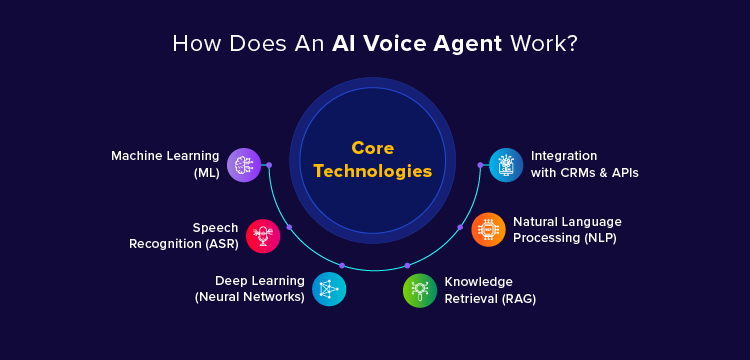
The working process of an Voice AI agent depends on a number of technologies. In this section, we’ll explore the step by step process of how these voicebots work and which technique/ protocol is used to establish a successful conversation.
1. Capturing The User’s Voice (Speech Input & Signal Acquisition)
- Microphone Array and ADC: When a user picks up a phone, opens your app and taps the voicebot icon, their device’s microphone starts prompting the user to speak. It starts recording the voice (which is an analog audio signal) and then converts into digital signal using an ADC (Analog-to-Digital Converter).
- Pre-processing: Do you think the captured voice signals will be super-clear? No right? There are going to be a lot of background noise and reverberations that need to be eliminated so the command is clear for the bot. This is where the technology uses spectral subtraction or adaptive filtering to perform noise reduction, echo cancellation and normalization.
2. Converting Speech to Text (ASR – Automatic Speech Recognition)
- Understanding Sounds (Acoustic Modeling): Since this is going to be a two-way conversation, the AI needs to understand the speech pattern of the user. For this, it uses Deep Neural Networks (DNNs) such as Convolutional Neural Networks (CNNs) or Recurrent Neural Networks (RNNs) to listen and analyse short frames of speech (about 25 milliseconds each). These networks extract acoustic features like Mel-frequency cepstral coefficients (MFCCs) or log-Mel filter banks to understand the sounds better.
- Guessing the Right Words (Language Modeling): Some sounds are really confusing. For example, a bot may confuse “there” for “their”. In these cases, the AI needs to decide on the exact word that makes sense in the sentence. For this it uses probabilistic models such as n-gram models or Transformer-based language models to compare the language rules and past conversations to predict the right words.
- Turning Sounds into Text (Decoding): In the next step, the AI puts everything together using a technique like beam search to pick the most likely words that match what your users said. It typically creates a transcript so that it can arrange the content with the most probable phonemes to words that are spoken by the user.
A few of the bots achieve language mappings and learn the acoustics accurately by using end-to-end models (like Listen, Attend, and Spell or Transformer-based models).
3. Natural Language Understanding (NLU)
- Intent Detection: After decoding, the bot needs to understand what exactly your user wants. Are they for a query? Do they need the bot to perform any particular action or do they need to make a payment? To understand all these, the bot uses BERT or RoBERTa to categorize the intent of the user. I understand these details by analyzing the voice-to-text data and categorizing them as query, command or a transaction.
- Entity Recognition: Now that the bot knows why the user is here, it needs further details to proceed the conversation further and serve the user better. It starts collecting information such as dates, locations, or product names, sequences them and maps them using Named Entity Recognition (NER) approaches like BiLSTM-CRF or transformer-based architectures.
- Semantic Parsing: Now that the bot has all the details it needs from the user, it starts to relate each of these information to understand the context better. So, it starts analysing them by creating dependency trees and semantic graphs.
4. Processing & Decision-Making
- Retrieval-Augmented Generation (RAG):
At this point, your bot will understand why the user has started the conversation and what they need. Now is the time for response. There are 2 ways it can answer the user query: - Retrieval Component: It can search the answer from a knowledge base you have uploaded or trained it with. If you already have not uploaded a knowledge base, you can create one using a knowledge base software.
- Generative Component: To come up with a good answer, it works kind of like how tools like GPT do. It looks at what the user asked and matches that with helpful information it finds using a search tool. Then, once it has what it needs, it puts together a clear and helpful response for the user.
5. How Responses Are Created
- Large Language Models (LLMs): Big AI systems like GPT come up with replies based on huge amounts of text they’ve read during training. They use something called attention layers to figure out which parts of the conversation matter most, so their answers stay relevant and on point.
- Post-Processing: Before the final response reaches you, there’s usually a quick clean-up stage. The system checks to make sure everything sounds okay, that it’s appropriate, and that it actually makes sense.
6. From Text to Speech (TTS)
- Breaking Down Speech: To sound more natural when talking, TTS (Text to speech) or systems first chop up the text into tiny sound pieces (called phonemes) and figure out the rhythm and pitch. That’s what helps it feel more like real, flowing speech instead of something robotic.
- How It All Comes Together: Some of the popular tools like Tacotron and Transformer TTS help figure out how the speech should actually sound. They consider timing, pacing, and transitions to keep everything smooth.
- Creating the Voice of the AI: Once everything’s mapped out, tools like WaveNet or WaveGlow step in to generate the actual voice and this is where the AI really starts to sound human.
Why Does Your Business Want an AI Voice Agent Platform?
Some people think AI voice tools are just out to replace real people. But that’s not really the case. At least not when they’re used right. In many everyday situations, they’re more like an extra pair of hands.
Here’s why bringing one into your business could be a smart call:
- Works Round the Clock
Humans need a break, sometimes. But your AI voice agents do not. They simply can work all the time. Whatever time it is, your customers will have assistance and continuous support. They need not stare blankly at the chats without responses, or listen to the boring IVR queue. Human touch is necessary.
Still, it’s good to give your people a few hours of rest while you have your own AI voice calling app with bot-agents to take care of things in their absence.
- Fast and Helpful Responses
Since you’ll feed in all the relevant responses and data to your voicebot, it can be quick and accurate. At least for basic/ regular questions, you can confidently employ a bot while utilizing your human resources to complex issues.
Your bot can do the pre-checks, appointment scheduling, order tracking, and basic troubleshooting before connecting to a human agent. This saves you a lot of time and resources.
- Cuts Support Costs
You’ll need human agents in your team for efficiency. However hiring or training a staff for the basic support operations might cost you billions of dollars.
Another point to consider is that a human can handle only one call at a time, while a bot can handle 100s of calls at the same time. This is why automating call handling saves you time and money for basic operations.
- Scales Easily
To handle unlimited interactions and in multiple languages at the same time, you need an army of multi-lingual support staff. As your business expands, you’ll need to bring in more resources. That’s a lot of investment.
On the other hand, if you need to pause the support operation for a time period, you’ll still have your resources, without having anything to work on. You can put them up in other departments.
During such scaling operations, you can easily deploy an AI voice agent, without having to mess up with resource management.
- Understands Customers Better
AI voice agents have a checklist of customer preferences, common complaints, and trends. They collect every detail, which sometimes would be missed in ‘human err’. They use almost all of them to understand the customer better and provide solutions accordingly.
With these bots, there’s no room for errors or wrong judgement, it simply works on the fed-in algorithms.
- Helps Everyone Communicate
AI-powered voice agents make customer service more inclusive for everyone. Even individuals with disabilities can get assistance with voice-based communication. These also allow hands-free interactions, which are helpful in situations like driving or gardening, where typing is not really convenient.
- Learns and Improves Over Time
A human agent has to understand the customer by reading their past call histories for at least a few minutes. Practically, the agent might not have a 100% understanding of the customer, as they had to do this simultaneously while speaking on the phone.
Contrastingly, an AI voice assistant uses advanced technologies like retrieval-augmented generation (RAG) to understand context better and provide accurate answers. They can also integrate with external APIs, access real-time business data, and remember past interactions to make conversations more natural and personalized.
Who Is Using AI Voice Agent Platforms Today?
The short answer is – ALL. Yet here is a list of industries and the corresponding use cases where AI Voice Agents are used for daily business operations. Check out each one of them to understand which of these operations you can use the bots for your business.
|
Industry |
AI Voice Agent Use Cases |
|
Customer Service |
|
|
Interactive Voice Response (IVR) Systems |
|
|
E-commerce |
|
|
Finance & Banking |
|
|
Healthcare |
|
|
Telecommunications |
|
|
Internal Business Operations |
|
|
Sales & Marketing |
|
|
Cybersecurity |
|
If you are already here, this is a good sign you are committed to building your AI voice agent platform. The internet has ample information that might overwhelm you.
So this is how it goes:
- You’ll get a reliable solution to build voice AI agents
- Integrate it into your platform
- Get your AI agent live!
That’s simple, right?
Now, if you are uncertain about which provider to choose, here is our carefully curated list of solutions that will not disappoint you!
40+ Key Features to Build a Custom AI Voice Agent Platforms
AI Voice agents come with a wide range of features, in fact, with advanced technologies that make support operations easy and quick.
In this section, I’ll walk you through some of the most popular AI Voice agent features and capabilities. Grab your pen or your keyboard to make a quick checklist so you can add them to your AI Voice Agent app development.
High Priority: Core Functionalities
- Speech Recognition & ASR: This feature accurately converts the words you speak into machine-understandable text.
- Natural Language Processing (NLP): Understand the natural language of a human to interpret the intent they are speaking with and the actual context of the conversation, rather than some random assumption. Just like in conversational search, where queries are understood in a more human, contextual way rather than through rigid keyword matching.
- Speech Synthesis & Voice Output: A voicebot does not sound robotic anymore. It synthesises the text and converts into natural, human-like speech. This is how voicebots like Alexa or Siri mimic human voice and tone.
- Context Awareness: AI audio agents can analyse an user’s past interactions within a fraction of seconds, so that it can deliver more accurate and relevant responses.
- Seamless Human Escalation: When the AI agent understands that it can’t handle a query or issue anymore, it transfers the call to a human agent, while retaining context as notes.
- Real-Time Processing: With AI agents, there’s no delay, really. Bots can quickly answer user queries in real-time, as they have answers automated in them already.
- Integration with Existing Systems: AI agents can connect pretty much easily with any third-party tools – CRM, ERP, and backend databases, just anything you want for your business operations.
- Scalability: Voicebots can handle unlimited interactions without performance issues. They are built for automation and can handle any scale of AI calls/ support operations.
- Cost Efficiency: A voicebot can do the work of 100 support resources at the same time. This means you’ll invest for 1 resource in the place of 100 resources, saving both time and money.
- Enhanced Efficiency: Carries out routine tasks like scheduling, FAQs, and troubleshooting.
Medium Priority: Advanced Capabilities
- Personalization: Voicebots throw the right questions and understand user preferences better. This way, they can deliver a customized experience to users.
- Multi-Language Support: Not just 1 language, your voicebots can communicate with your customers in any language. This means you can reach global customers even without having human resources from a multi-lingual background.
- Advanced Data Analytics: These bots can keep a track of customer behavior on your platform and use these insights for support operations and recommendations based on their preferences.
- Proactive Engagement: You don’t need to instruct a voicebot with daily huddles. It can initiate calls/messages for reminders, follow-ups, and promotions on its own.
- AI-Powered Recommendations: AI agents understand customer preferences well. It suggests relevant products, services, or solutions at the right time!
- Predictive Analytics: This is one of the key features in an AI voice call app that can anticipate the needs and preferences of your customer and provide proactive solutions.
- Dynamic Call Routing: It can easily direct calls to the right department or agent.
- Fraud Detection & Security: Your AI audio agent can identify suspicious activities on your platform and take corresponding security measures immediately.
- Voice Biometrics: Your human agents or customers do not need a thumb print or an OTP to access your platform. They can use voice recognition for secure authentication.
- Omnichannel Integration: It just works everywhere – across phone calls, messaging apps, web platforms, and smart devices.
Lower Priority: Specialized Features
- Industry-Specific Customization: You can customize a voice bot for any industry and any use case – for healthcare, finance, sales or edtech. Employ wherever you need and train it just the way you want.
- Automated Survey & Feedback Collection: These bots are capable of gathering customer feedback via voice interactions.
- Virtual Receptionist: It easily manages call screening, scheduling, and inquiries. It just acts as a receptionist to your customers.
- Multimodal Interaction: Not just voice, these bots can work with text inputs too. It is not limited to only audio conversation.
- Call Summarization & Transcription: It can automatically log and summarize conversations.
- Cloud-Based Operation: Ensures easy updates and remote access.
- Low-Latency Response: There’s no delay when it processes user input and gives a response.
- Noise Cancellation: Filters all the background noise so it can understand inputs clearly.
- Sentiment Analysis: Detects customer emotions and adjusts its responses accordingly.
- Crisis & Emergency Handling: It’s never sluggish. Bots provide quick support in urgent situations.
- Customizable Voice & Tone: Adjusts voice style to match your brand’s identity.
- Hands-Free Operation: You can control the bot with only voice, without having to touch your device.
- Compliance & Data Security: Most bots are built to be compatible with industry laws and regulations like GDPR and HIPAA.
- Processing & Decision Making: Uses AI-driven logic for giving customers quick resolutions to their queries.
- Real-Time Network & Threat Analysis: Monitors and prevents any unusual security threats or activities with its built-in encryption system.
- Audio Capture & Speech Input: It can accurately process voice commands.
- Voice-Based Shopping & Transactions: Supports processes like purchases, payments, and order tracking.
- AI Voice Assistants in Healthcare: Some of the top AI voice assistants now can be seen operating as front-desk assistants to schedule appointments, reminders on medication and assessments.
- Automatic Speech Recognition (ASR): Accurately recognises the voice of a person and understands the context.
- Multi-Device Compatibility: You can employ an AI virtual assistant on literally any device – IVR, smartphones, and smart speakers.
10 Steps To Create a Custom AI Voice Agent (With MirrorFly)
We’ve reviewed the top 10 AI Voice Agent solution providers. In this section, I’ll explain how to build a complete AI Agent with MirrorFly.
For this, you’ll need to get ready with the following pre-requisites:
- Android Lollipop 5.0 (API Level 21) or above
- Java 7 or higher
- Gradle 4.1.0 or higher
- targetSdkVersion,compileSdk 34 or above
Step 1: Add MirrorFly Repository
Open Android Studio and either create a new project or open an existing one.
Depending on your Gradle version:
Gradle 6.8 or higher:
Add the following configuration to your settings. gradle file.
dependencyResolutionManagement {
   repositories {
       jcenter()
       maven {
           url "https://repo.mirrorfly.com/release"
       }
   }
}
Gradle 6.7 or lower:
Instead, place the configuration in your root build.gradle file.
dependencyResolutionManagement {
   repositories {
       jcenter()
       maven {
           url "https://repo.mirrorfly.com/release"
       }
   }
}
Step 2: Add Dependency
In your module-level build.gradle file (app/build.gradle), add the necessary dependencies under the dependencies block.
dependencies {
    implementation 'com.mirrorfly.sdk:mirrorflysdk:7.13.16'
 }
Step 3: Fix Jetifier
To prevent conflicts between imported libraries, add the following line to your gradle.properties file.
android.enableJetifier=trueStep 4: Add Runtime Permissions
Click here to give runtime permissions to your Mic and Internet.
Step 5: Initialize SDK in Application Class
Before initializing the SDK, make sure the required prerequisites are in place.
In your Application class, override the onCreate() method and call the appropriate method from ChatManager to pass in the necessary configuration data.
ChatManager.initializeSDK("LICENSE_KEY", (isSuccess, throwable, data) -> {
            if(isSuccess){
                Log.d("TAG", "initializeSDK success ");
            }else{
                Log.d("TAG", "initializeSDK failed with reason "+data.get("message"));
            }
        });
Step 6: Register User
Use the method below to register a user in sandbox live mode, depending on the setIsTrialLicenceKey flag provided.
FlyCore.registerUser(USER_IDENTIFIER, (isSuccess, throwable, data ) -> {
        if(isSuccess) {
            Boolean isNewUser = (Boolean) data.get("is_new_user");  // true - if the current user is different from the previous session's logged-in user, false - if the same user is logging in again
            String userJid = (String) data.get("userJid"); //Ex. 12345678@xmpp-preprod-sandbox.mirrorfly.com (USER_IDENTIFIER+@+domain of the chat server)
            JSONObject responseObject = (JSONObject) data.get("data");
            String username = responseObject.getString("username");
        } else {
           // Register user failed print throwable to find the exception details.
        }
   });
Step 7: Setup Call Activity
Configure your activity in AndroidManifest.xml
Set with:
CallManager.setCallActivityClass(YourCallActivity.class);Step 8: Build the AI Logic for the Voice Agent
To implement the core intelligence of your voice agent, follow these steps:
Speech-to-Text (STT)
- Use an STT engine like Google Speech API, Whisper, or Vosk.
- Capture the audio stream from MirrorFly’s real-time stream.
- Pass the audio buffer to your chosen STT engine.
- Transcribe the user’s speech input to text.
Natural Language Processing (NLP)
With the transcribed text in hand, process it using an NLP engine such as:
- OpenAI GPT
- Dialogflow
- Rasa
- Or your own custom intent handler
Parse the user’s intent and generate an appropriate textual response.
Text-to-Speech (TTS)
Convert the AI-generated response text back into speech using:
- Google Text-to-Speech
- Amazon Polly
- Microsoft Azure TTS
Play the generated audio using Android’s MediaPlayer or AudioTrack.
Step 9: Handling Call Lifecycle for the AI Voice Agent
- MirrorFly manages the call UI and session flow.
- You’ll need to hook your AI logic into the call lifecycle callbacks to ensure it activates and responds appropriately during the call.
Note: These are custom set up, you may need to contact MirrorFly Team to set this up tailored for your team.
Step 10: Handle Call Events [Optional]
After setting the ChatConnectionListener, you’ll start receiving connection status updates through its callback methods.
Use these callbacks to monitor and handle changes in the chat connection state (e.g., connected, disconnected, reconnecting, etc.).
ChatManager.setConnectionListener(new ChatConnectionListener() {
   @Override
   public void onConnected() {
       // Write your success logic here to navigate Profile Page or
       // To Start your one-one chat with your friends
   }


   @Override
   public void onDisconnected() {
       // Connection disconnected
   }


   @Override
   public void onConnectionFailed(@NonNull FlyException e) {
       // Connection Not authorized or Unable to establish connection with server
   }


   @Override
   public void onReconnecting() {
       // Automatic reconnection enabled
   }
});
Getting Started With MirrorFly AI Voice Agent
Creating an AI voice assistant might sound complicated, but with MirrorFly, it’s actually a smooth and simple process that can be customized just for your business. Whether you want to improve customer service, make certain tasks automatic, or build smart voice features, MirrorFly gives you a platform that you can shape however you need.
You’ll have full control over your data, can set your own security rules, and choose where everything is hosted. It also works with standard calling systems like SIP and VoIP. On top of that, you can put your own branding on everything, get help from a dedicated development team, and even own the entire source code, giving you the freedom to create exactly what you want.
Want to build your own voice assistant? MirrorFly is ready to help. Contact our team today!
FAQ
Vapi AI, MirrorFly, Apphitect, Bland AI, and Telnyx are the best for building a real-time voice AI agent for phone calls. They focus on minimal latency, accurate speech recognition, and easy integration across existing systems.
Yes, customer service, e-commerce business, finance, healthcare, telecom, and real estate use an AI voice agent to handle calls 24 hours a week.
The best AI voice agents depend on specific needs. Vapi AI is a developer-first choice, and MirrorFly is a leading self-hosted solution. ElevenLabs is best for creating highly realistic voices, and SynthFlow is best as a no-code AI Voice Agent.
Deepgram, MirrorFly, CallHippo, and Bland AI are some of the best voice agents for customer support. The choice is based on factors such as enterprise scalability, ease of setup, natural conversation, and seamless integrations.
The pricing varies by provider, ranging from one-time license fees to pay-as-you-go models. Some monthly plans can be as $0.002 per user per day, while others charge based on call volume or usage.
First, select and configure your speech-to-text (STT), text-to-speech (TTS), and large language model (LLM). Then define the conversational logic, tone, and persona. Secondly, ingest the custom knowledge base, configure actions or APIs for real business tasks. Finally, test the workflow before deploying.
AI agents in healthcare automate and support tasks of staff and patients. It integrates with the EHR system to handle documentation, schedule appointments, and make personalized treatment plans.
Yes, the AI acts as a virtual receptionist to the customers. It handles appointment booking, manages call screening, and answers FAQs. It reduces the chances of missed calls from customers.
Build Your Own White-label AI Voice Agent With MirrorFly for your business.
Connect with our specialists and get your custom build + deployment plan. Get started with our solution in the next few minutes!
Contact Sales Complete Ownership
-
Custom Security
-
On-Premise Hosting
 Complete Ownership
 Atchaya Jayabal leads Content at MirrorFly and is an expert in writing Tech, SaaS & B2B. She regularly publishes articles on CPaaS & Conversational AI in blogs.