


TLDR
- A chatbot follows pre-set rules and scripts to respond to user inputs.
- Conversational AI chatbot understands context, learns from interactions and behaves like a human being.
- Chatbot and conversational AI are two different solutions. So, learn the difference and see which one suits your business needs in 2026.
- A chatbot is fast, while conversational AI offers intelligent, human-like responses and improves over time.
Chatbots and conversational AI chatbots are terms that get thrown around in product demos, marketing decks and vendor pitches all the time. But they are two different things. Treating them equally is one of the most expensive assumptions a company makes when it invests in communications technology.
This guide cuts through the confusion about what chatbots and conversational AI are, breaks down their key differences, how they’re used and where each one shines. This way you can find out which one is perfect for your business.
What Is a Chatbot?
A Chatbot is a software program that can simulate talking to a human on a website, app or messaging service. In simple words, it basically takes a text input and returns a valid response.
But all chatbots are not created equal. There are two types:
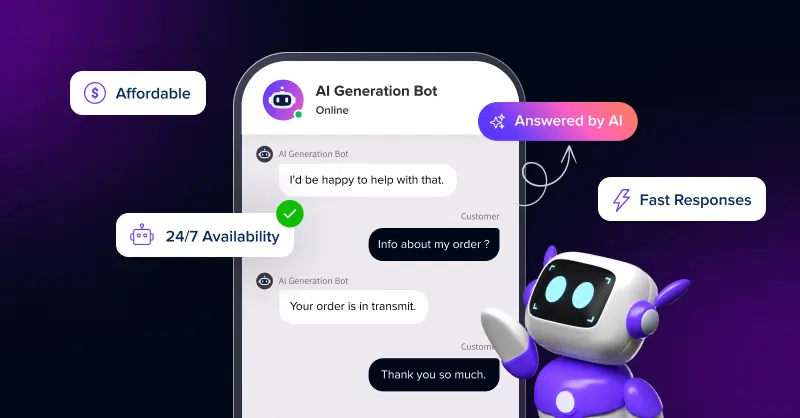
- Rule-based Chatbots are the most basic ones as they function on decision trees, script-based or button-based bots. It uses an if-this-then-that logic, meaning if you type “refund” the bot responds with refund policy.
- AI Chatbots are contextual chatbots or virtual agents. They use natural language processing (NLP) and machine learning (ML) to understand user intent and respond with a custom relatable message. It is flexible, follows the conversation and improves with time.
- Fast and Affordable to Deploy – Take your chatbots live in hours and not weeks with little technical knowledge.
- 24/7 Availability – Answers customer queries at any time without the need to add staff.
- Scales Effortlessly – Manages and handles thousands of simultaneous conversations instantly.
- Reduces Operational Costs – Automates repetitive high-volume interactions that would require human agents.
- Consistent Responses – Every customer gets identical and on-brand responses every time without any variation.
- Easy to maintain – Rule-based chatbots only need to be updated if your content or policies are changed.
- Not Ideal for Off-Script – The bot breaks outside the script when someone asks an unexpected question.
- Lacks Context Retention – Most basic chatbots consider every message as a new one without any memory.
- Very Limited Personalization – They respond the same way for every user, regardless of history, behavior or preference.
- Not For Complex Queries – A chatbot cannot handle complex questions as it works on a rule-based process or specified keyword.
- Requires Constant Content Maintenance – Scripts need constant updates as products, policies and processes change.
What Are Chatbots Used For?
Chatbots are everywhere you see like apps, websites, software and more, but for a good reason. They’re quick to deploy, inexpensive and can handle large numbers of repetitive interactions very well. Here’s how businesses use them:
1. Customer Support FAQs
The most common use case for a chatbot. Chatbots handle routine questions like store hours, return policies, shipping status and password resets without humans involved. And they’re available 24/7 to help you out with problems that actually don’t need human judgment.
2. Lead Generation & Qualification
On landing pages, business chatbots engage with visitors by asking qualifying questions, taking their contact details, and scoring leads before a sales rep arrives. According to Statista’s recent study, chatbots have helped increase lead generation by up to 55% compared to traditional contact forms.
3. E-Commerce & Order Management
Chatbots take care of all the repetitive operational queries that flood e-commerce support teams, especially during peak seasons when ticket volumes skyrocket. It handles from tracking orders to processing returns and replying to product questions.
4. Appointment Scheduling
Healthcare clinics, salons and service businesses use chatbots to book appointments. Customers can book, reschedule and cancel in a click and need not stand in a queue. This helps businesses to manage their customers better.
5. Onboarding & Guided Experiences
Chatbots help new users set up products, collect onboarding data and answer first-time questions to cut churn in the early days of the customer relationship. This simple initial setup is handled by chatbots, while experts can deal with complex support.
6. Internal HR & IT Helpdesk
Enterprises are using chatbots internally to answer employee questions about company policies, IT password resets and leave requests, all without adding headcount to HR and IT teams. This way companies can avoid tons of emails and avoid repetitive tasks.
What Is Conversational AI?
Conversational AI enables machines to learn, understand, process and respond to users in a natural, intelligent and contextual way. These conversational chatbots are what help voice assistants like Siri, Alexa and Google Assistant to understand us and answer accordingly.
On the technical side of things, conversational AI has several layers:
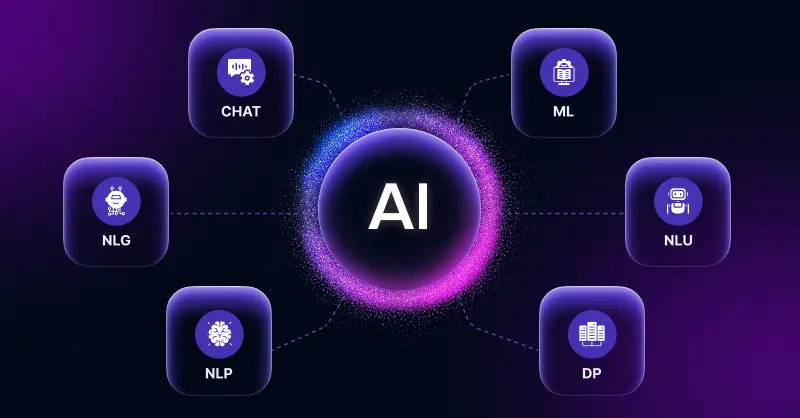
- Natural Language Understanding (NLU) interprets what the user means instead of what they typed.
- Natural Language Processing (NLP) processes the structure and meaning of language inputs.
- Machine Learning (ML) learns from past interactions to improve future responses.
- Natural Language Generation (NLG) creates and delivers human-like responses.
- Dialogue Management manages and maintains the content flow of multi-turn conversations.
You can even build your own custom AI chatbot to function as per your needs. A rule-based chatbot simply breaks when the user goes off-script, while conversational AI handles uncertainty, maintains context in a conversation and responds dynamically in a more natural tone.
- Context-Aware Conversations – It remembers what was said earlier and responds accordingly, so no need for users to repeat themselves.
- Handles Complexity and Off Script – Understands various phrasings, follow-up questions and multi-intent messages without breaking.
- Learns & Improves Constantly – Every conversation the bot has is a data point, which makes the system measurably more accurate over time.
- Delivers Personalized Experiences – Delivers customized responses that are adapted to user history, preferences and real-time behavior.
- Multilingual & Omnichannel – Operates across all languages and all channels like web, mobile, voice, WhatsApp and more from a single platform.
- Cost Reduction – Businesses can save up to 30% on customer service costs after adopting conversational bots, as cost-per-interaction drops when dealing with high volume.
- High Initial Investment – Building and training a conversational AI system takes more time, data and money than building and training a basic chatbot.
- Needs Quality Training Data – The bot is trained based on the data you feed, so if you provide poor training data, then it produces poor responses for your users.
- Can Still Get Things Wrong – Even the best conversational AI chatbots sometimes misunderstand intent, especially when using highly specific language or unusual phrasing.
- Ongoing Maintenance Require – Models need to be retrained as language improves, new use cases appear and product offerings change.
- Privacy and Compliance Complexity – Data handling, storage and compliance are more complex when processing natural language at scale than with basic chatbots.
What Can Conversational AI Be Used For?
Conversational Artificial Intelligence goes beyond just answering FAQ questions. It can understand user context, learn from interactions and handle complexity in ways that normal rule-based chatbots cannot.
1. Advanced Customer Service
AI chatbots for customer support understand follow-up questions, deal with uncertainty and handle complex multi-turn support conversations in seconds. This is something impossible for a rule-based chatbot to handle.
2. Telehealth & Healthcare
Hospitals and digital health platforms use conversational AI for patient intake, symptom triage, appointment scheduling, medication reminders and HIPAA compliant physician-patient communication for clinical-grade interaction.
3. Banking & Financial Services
Banks use conversational AI bots to answer account inquiries, detect fraud, assess loan eligibility, add it to a video KYC ecosystem and handle transaction disputes securely and around the clock without sending every query to a human agent.
4. E-Commerce Personalization
Unlike basic bots that respond to every user the same way, AI-powered conversational chatbots make product recommendations, recover abandoned carts with targeted messaging and help customers make complex purchase decisions based on behavior and preference data.
5. HR Automation & Employee Experience
Conversational AI is used internally by enterprises for employee onboarding, IT helpdesk automation, performance review support and policy Q&A to reduce administrative load on HR and IT teams.
6. Education & eLearning
EdTech platforms deploy white-labeled conversational AI chatbots to act as virtual tutors, study companions and enrollment assistants for providing a personalized learning support for thousands of students at once.
7. IVR & Voice Assistants
The conversational AI-based voice interfaces are replacing rigid IVR phone trees with natural, flowing voice conversations that understand what callers are saying instead of forcing them to select from numbered menus.
Chatbot vs Conversational AI: What are the Key Differences?
| Factor | Rule-Based Chatbot | Conversational AI |
| Core Technology | Decision trees, keyword matching | NLP, NLU, ML, LLMs |
| Response Type | Pre-written, scripted | Dynamically generated text |
| Context Awareness | None, as each message is isolated | Full, as it retains conversation history |
| Handles Ambiguity | No, it breaks on unrecognized inputs | Yes, it understands varied phrasing |
| Learning Ability | Static, never improves | Improves with every interaction |
| Personalization | None | High, it adapts to user history and behavior |
| Multi-Turn Conversations | Limited | Native capability |
| Multilingual Support | Requires manual translation | Built-in with NLP models |
| Setup Complexity | Low and fast to deploy | High and requires training and configuration |
| Ongoing Maintenance | Content updates only | Model retraining and performance monitoring |
| Best For | FAQs and simple guided flows | Complex, human-like and multi-turn conversations |
| Cost | Lower initial cost | Higher initial cost but worth for long-term and high-volume use |
Which Is Best for Your Business: Chatbot or Conversational AI?
A question that lurks in everyone’s mind. So, the best answer for the question depends on what your users want from the conversation they have.
A rule-based chatbot is ideal if:
- You need something that can be done quickly with minimum tech investment.
- You and your team lack the resources to train and maintain an AI model.
- Your conversation volume is low and your queries are repetitive.
- Your use is simple and predictable like FAQ responses, order status updates and basic lead capture.
A conversational AI is Ideal if:
- Customers ask you broad or complex questions that are not scripted.
- You want the bot to remember context across multiple turns.
- Personalization matters as you want your users to be listened to, not processed.
- You are working at scale and want the system to get better over time
- You work in a regulated space like healthcare, fintech or legal where nuance is more important than compliance.
If you’re looking for the best of both? Here’s what you can do:
Start with a rule-based chatbot for high-volume and predictable queries, then add conversational AI for everything else.
A well-architected conversational AI chatbot can do both simple scripted flows and more complex natural language conversations in the same interface, giving your users a seamless experience.
It’s not about chatbots or conversational AI, the real question is “what does my customer need from this interaction?” and from there, the right solution becomes noticeable.
But you’ll be wondering which platform offers the best chatbot and conversational AI solution to remove the hassle. That’s why we have listed out the 10 best conversational AI Chatbots of 2026. Here you’ll find a clear breakdown of features, pricing and who each one is best for.
Wrapping It Up
The prime difference between chatbot and conversational AI chatbot isn’t just technical but experimental. A chatbot follows a script and breaks if users go off-script. While the conversational AI adapts, learns and improves constantly without any human intervention.
So, more and more teams are moving towards a fully owned conversational AI solution like MirroFly, where you get a white-labelled, self-hosted AI chatbot with complete source code access.
Start by knowing what your users need. Map your most common interactions. Choose the technology that fits and not the one with the best demo.
Deploy conversational AI that automates interactions and enhances customer experiences with intelligent automation.
Contact Sales Omnichannel Support
-
1000+ Features
-
Context-Aware AI
 Omnichannel Support
 A technical content marketer specializing in Real-time Communication Solutions, adept at making complex concepts easy to understand.